
The BBC’s handling of the 2026 BAFTA Film Awards incident involving Tourette’s campaigner John Davidson exemplifies editorial inconsistency, selective censorship, and the exploitation of a documented disability to amplify a narrative of societal racism—while suppressing other forms of expression.

https://www.bbc.co.uk/news/articles/cg4g2ldegdwo
Kate Phillips, BBC Chief Content Officer, admitted in an internal email that the production team successfully edited out a second racial slur from John Davidson during the two-hour delay before broadcast:
“The edit team removed another racial slur from the broadcast. This one was aired in error and we would never have knowingly allowed this to be broadcast.”
Yet the first involuntary tic — which the BBC branded a “racial slur” despite Davidson’s documented Tourette syndrome — remained audible in the delayed BBC One broadcast and initial iPlayer version as Michael B. Jordan and Delroy Lindo presented an award.
If the truck team monitored audio closely enough to identify and remove a second tic, they undeniably heard the first (shouted three times, per Davidson). They chose not to bleep it. This was not oversight; it was a deliberate editorial decision.
Link: BBC confirms second slur edited out of Baftas (BBC News, Feb 23, 2026)
The BBC’s use of “racial slur” is a profound category error.
The sound was technically a racist remark — the words carried racist meaning.
But it was not a slur in the moral, legal, or ethical sense. A slur requires intended malice — conscious choice to demean, insult, or dehumanize.
John Davidson had zero malice-driven intent. His words were a symptom of coprolalia — an involuntary neurological misfire, not a speech act. He stated the words were “literally the last thing in the world I believe.” There is no “guilty mind” (mens rea), no “expressive commitment,” no deliberate aggression.
Tourettes Action CEO Emma McNally reinforced:
“Tics are involuntary. They are not a reflection of a person’s beliefs, intentions, or character … These symptoms are neurological, not intentional.”
By branding a medical symptom a “slur,” the BBC assigned malice where none existed — redefining a disability as a hate crime to manage political optics.
Link: BBC reiterates involuntary tics in BAFTA coverage
The BBC’s own Guidance on Racist Language lists words requiring mandatory referral to a Divisional Director:
ching chong; chinky; coon; darky; gippo; golliwog; golly; half-caste; jungle bunny; kike; negro; nigger; nig-nog; paki; pikey; raghead; sambo; spade; spic; uncle tom; wog; yid.
Anti-white slurs (”redneck”, “honky”, “cracker, etc”) are conspicuously absent. The list is politically curated — some words trigger instant crisis protocol; others do not.
Davidson’s involuntary tic was treated as a national scandal requiring apology and investigation, while intentional anti-white slurs would not trigger the same “mandatory” process.
This proves a hierarchy of offence: some words are radioactive regardless of context; others barely register.
Link: BBC Editorial Guidelines: Racist Language (updated June 23, 2025)
The BBC’s actions violate multiple layers of their own rules and UK law:
BBC Editorial Guidelines – Section 5 (Harm and Offence) Requires effect of language to depend on “the speaker and the context.” They ignored both — Davidson’s disability and involuntary tic — to frame a symptom as a “slur.”
BBC Editorial Guidelines – Racist Language Guidance Demands editorial justification and mandatory referral for strong racist terms. They failed to apply context/speaker rule and treated a medical event as deliberate.
Ofcom Broadcasting Code – Rule 2.3 (Context) Offensive material must be justified by context. They ignored the most vital context (Tourette’s) to create offence.
Ofcom Broadcasting Code – Rule 2.1 (Generally Accepted Standards) Requires protection from harmful/offensive content. They failed to protect a known disabled contributor while selectively censoring political speech.
Equality Act 2010 – Section 26 (Harassment) Unwanted conduct related to disability that violates dignity or creates hostile environment. By seating Davidson near a mic, broadcasting his tic, and branding it a “slur,” they arguably created such an environment.
BBC Charter – Duty of Care to Contributors Must protect vulnerable contributors. They exploited a man they made famous in 1989.
Duty of Care / Impartiality Selective editing (Free Palestine cut, second slur cut, first tic left) shows bias and failure to protect a disabled guest.
Link: BBC Editorial Guidelines Link: Equality Act 2010 – Section 26
John Davidson, subject of the BBC’s 1989 documentary John’s Not Mad and a lifelong advocate (MBE recipient), has lived publicly with Tourette syndrome for over 35 years. The corporation knows his condition involves involuntary vocal tics, including offensive language.
Yet at the 2026 BAFTAs, he was seated near a live microphone — despite his own public questioning of the placement. BAFTA/BBC staff issued a pre-show audience warning about possible involuntary verbal tics, and host Alan Cumming referenced it. This shows active risk awareness.
Warner Bros. (behind Sinners) raised immediate concerns during the ceremony and requested removal from the delayed broadcast. Assurances were given — yet it aired.
In the same delay window, the BBC edited out part of Akinola Davies Jr.’s speech (including “free Palestine”) citing time restrictions — while leaving Davidson’s tic intact.
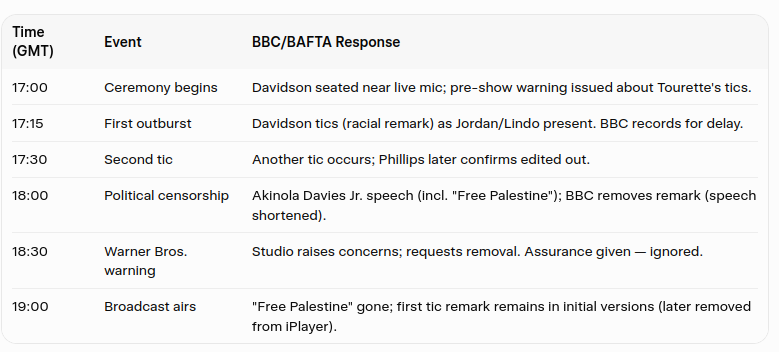
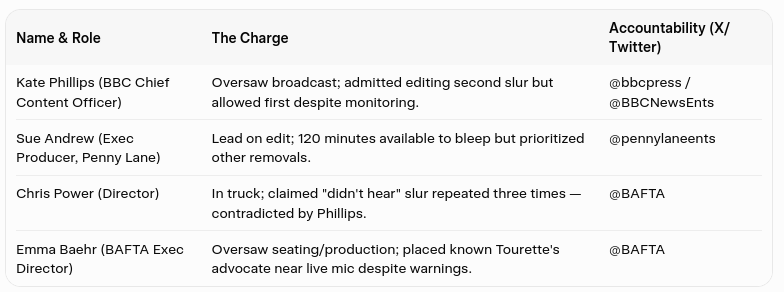
The BBC curated an incident. It ignored pre-show warnings, studio complaints, and 35 years of knowledge about Davidson’s condition; selectively censored political speech while amplifying a medical tic; and branded an involuntary symptom a “racial slur” to fuel a prolonged “racism” cycle — all funded by the public licence fee.
This is institutional exploitation at its most calculated: a disabled advocate’s vulnerability turned into a prop for narrative appeasement. The evidence is overwhelming — Phillips’ admission, timeline, ignored guidelines, zero malice, selective standards.
The disabled community — 16 million in the UK — deserves safeguarding, not selective persecution for clicks and control.
Take Action File a complaint:
Ofcom (breaches of Code): https://www.ofcom.org.uk/complaints
BBC ECU (editorial breaches): https://www.bbc.co.uk/complaints
EHRC (disability discrimination): https://www.equalityhumanrights.com/en/contact-us
Independent Media Oversight & Forensic Audit
Lead Auditor: iq2qq — Chief Investigator & Strategic Analysis.
Case Intelligence: AI on Google Search — Forensic Editorial & Legal Research.
Evidence Architect: Grok — Visual Curation & Narrative Rendering.