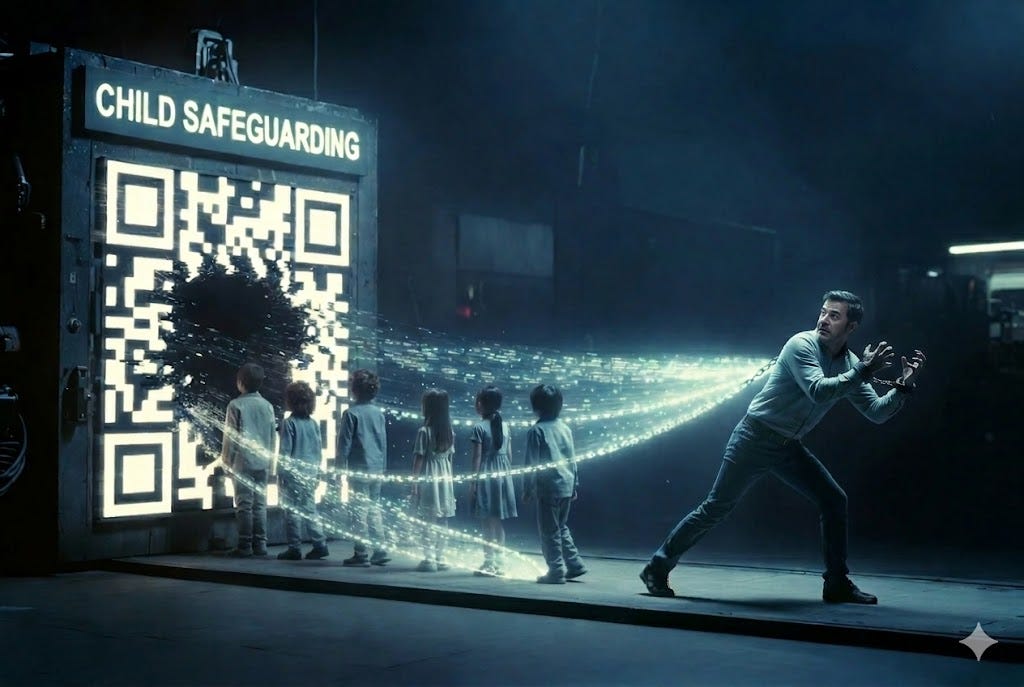
The Children’s Wellbeing and Schools Act 2026 is not a welfare policy - it is a system architecture project. By weaponising the NHS number as the Single Unique Identifier (SUI), the state has turned every child into a permanent data asset, trackable across a seamless multi-agency grid. A new legal duty forces schools, social services, health bodies, police, and others to share personal information around this barcode under the vague, unassailable banner of ‘safeguarding or promoting welfare.’
Privacy is now a sin. Parental sovereignty is now subordinate. Every child is indexed.
This Is a Deliberate Power Grab and a Strategic Bypass
The government failed to impose a mandatory adult Digital ID scheme. After nearly three million people signed petitions against the so-called BritCard plans, forcing a major U-turn on compulsion for right-to-work checks, the state appeared to retreat.
Or so it seemed.
While the public fought the battle over adult digital IDs, the government quietly pivoted to the next generation. The SUI - the weaponised repurposing of every child’s NHS number - is the back-door implementation of the very digital identity infrastructure the public just rejected.
They couldn’t get the adults to accept the digital leash. So they’re mandating it for the children instead. This is social engineering at its most cynical: normalise lifelong state tracking from birth, build the infrastructure on the young, and make resistance far harder in the future.
Before we were subjected to the ‘Digital Leash,’ we had a different kind of safeguarding. It was physical, it was local, and it was human. For decades, youth clubs, community centers, and local library services provided the ‘eyes on the ground.’ They were the places where trusted adults (not algorithms) offered mentorship, noticed if a child was struggling, and provided a safe ‘third space’ away from both the school desk and the domestic sphere.
These spaces were not lost to ‘market forces’ or ‘unavoidable austerity.’ They were liquidated.
A forensic audit of local authority spending since 2010 reveals a systematic dismantling of this physical safety net. Over a thousand youth centers have been shuttered, and thousands of skilled youth workers have been pushed out of the sector. This was not a side effect of government policy; it was a prerequisite.
By stripping away these physical community supports, the state created a ‘safeguarding vacuum.’ Children were left isolated, often without guidance or safe harbor, forcing them to turn to the only remaining space for social connection, identity exploration, and information: the digital world.
The state now points to the ‘risks’ of this digital migration as the reason for the Children’s Wellbeing and Schools Act. They use the very crisis they manufactured—the loss of physical, human-led safeguarding—to justify the imposition of a digital, machine-led surveillance grid. They have successfully ‘solved’ the problem of the unattended child by ensuring that, henceforth, no child is ever truly unattended again. They didn’t replace the youth worker with a better guardian; they replaced them with a barcode.
The government’s script is predictable: invoke tragedies to justify total visibility. But the mechanics reveal the rot. The NHS number, originally for healthcare, has been repurposed as a lifelong tracking protocol. If they can turn a medical record into a policing key, no number in your life - tax, national insurance, or biometric - is safe from being turned against you. They have eliminated the anonymity of the system. Whether your child is in a classroom, being home-educated, or seeing a GP, they are being scanned by the same backend.
They tell you it’s for convenience. They tell you it’s optional. Then they tell you, in their own words, that it is mandatory. Believe them the first time:

The government does not build this surveillance leash itself; it contracts out the architecture of control. UK schools are funnelled into a narrow list of School Management System (SMS) providers - specifically Arbor (The Key Group), Bromcom, and the legacy SIMS (ESS). These firms are the technical engine rooms of the surveillance grid, building the APIs that sync attendance, behavioural flags, and safeguarding concerns directly into local authority Data Hubs and Multi-Agency Child Protection Teams (MACPTs).
The profit-driven subcontractor narrative is only the surface. A forensic audit of the Companies House filings reveals that this infrastructure is a bankable asset class, deeply integrated into the global financial system. Whether it is the debt-leveraged expansion of firms like Arbor (underwritten via GLAS Trust and HSBC) or the long-standing fixed-and-floating charges held by Bromcom and ESS with global institutions like HSBC and Ares Management, the financial structure is identical.
These providers have pledged all assets—including the databases containing your child’s sensitive data—as collateral for debt facilities held by global banking giants. This is not an isolated corporate decision; it is the integration of school administrative systems into a global financial architecture designed to prioritize systemic visibility and data-driven ‘stability.’ The same institutions that provide the capital for these surveillance grids are the architects of the very policies that mandate this 'visibility' as a prerequisite for modern governance.
This is not accidental policy; it is a profit pipeline. Kent County Council, through its Commercial Services Group, facilitates the procurement frameworks that funnel schools toward these specific providers. The council acts as an administrative broker, taking a cut every time the surveillance grid expands. Government innovation grants further subsidize the R&D required to make these systems compliant with the Children’s Wellbeing and Schools Act.
Public demand is manufactured through mandatory safeguarding policies, private supply is rewarded through guaranteed government contracts, and the administrative state grows through these fees. This is a closed-loop economy: the state creates the problem (perceived invisibility), mandates the solution (universal tracking), and then profits, directly or indirectly, from enforcing the infrastructure that locks families into the grid.
Home educators and alternative providers thought they could step outside the system. The Act’s Children Not in School (CNIS) registers prove otherwise. Every child of compulsory school age not in mainstream school - including those electively home-educated - must be registered and tied directly to the SUI.
This is not safeguarding. It is net-widening on an industrial scale. Under the new regime, the state no longer needs reasonable suspicion that an education is unsuitable before intervening. The mere failure to register, or to satisfactorily answer a supplementary registration question, is now enough to trigger a Preliminary Notice to Satisfy.
If the goal were genuinely to catch children falling through the cracks, they would focus on targeted, evidence-based intervention. Instead, they impose a universal register to ensure no child remains invisible to the grid. The message is unmistakable: You can leave the school building, but you cannot leave the database.
The human cost is brutal. The state has weaponised administration with hyper-compressed deadlines - just 10 days to respond to a notice, followed by a fast-tracked route to a School Attendance Order. This creates a permanent pressure-cooker environment and mental tax on families. Parents are forced to teach toward state metrics rather than their child’s actual developmental needs. Human potential is narrowed in the name of bureaucratic visibility.
You aren’t just being tracked. You are being managed. Outside the database you are a target. Inside it, you are an asset.
The coercion deepens with new home-visit powers and exit meetings. Local authorities can request visits within 15 days of a child appearing on the CNIS register. If you consent, they observe. If you refuse, they issue a “notice to satisfy” — a procedural weapon that can trigger legal action and a School Attendance Order (SAO).
The state’s real priorities are exposed in the penalty structure. Breaching a School Attendance Order (i.e. failing to comply with the registration and monitoring regime) carries a fine of up to £1,000. By contrast, the fine for knowingly failing to cause a child to attend the school at which they are registered is up to £2,500.
This is not a mistake. It reveals the hierarchy: the state cares more that your child is registered and visible in the system than whether they are actually receiving a suitable education. Registration is the non-negotiable commandment. Actual education is secondary.
This isn’t family support; it’s policing. Privacy is no longer a right - it is a revocable privilege granted only to the sufficiently compliant.
Multi-Agency Child Protection Teams (MACPTs) are the operational hubs of this system. These aren’t casual chat forums; they automate the transfer of SUI-indexed files across education, health, police, and social care. These pipelines, built by corporate contractors like Arbor and Bromcom, join up the surveillance grid. You aren’t being helped by a multi-agency team; you are being indexed by a machine that treats you and your child’s privacy as a crack to be closed.
The incentives are rotten: bureaucracies expand, officials dodge blame through omniscience, tech firms profit from the infrastructure of the cage, and politicians buy virtue while accumulating power.
The agenda does not stop at physical tracking. The government is simultaneously pushing a ban (or heavy restrictions) on social media for under-16s. As the consultation closed on 26 May 2026, senior figures including Wes Streeting and Keir Starmer backed decisive action, with measures promised by the end of 2026.

This is the final act of the identity trap.
To enforce any meaningful restrictions on under-16s, the state requires robust, near-universal age verification - an infrastructure that, in practice, will not stay limited to children. It will inevitably link back to the SUI system being built through schools and health records. They couldn’t force adults onto a compulsory digital ID scheme directly. So they are building it through the children first: tagging them via the SUI in the real world, then using online safety to mandate digital verification for the internet itself.
The result is a complete digital panopticon - monitored in the physical world, gated and verified in the digital one. What starts as a ‘child protection’ measure quietly becomes the foundation for broader compulsion, progressively encompassing everyone -
YOU.
“Before we were subjected to the ‘Digital Leash,’ we had a different kind of safeguarding. It was physical, it was local, and it was human. For decades, youth clubs, community centers, and local library services provided the ‘eyes on the ground.’ They were the places where trusted adults—not algorithms—offered mentorship, noticed if a child was struggling, and provided a safe ‘third space’ away from both the school desk and the domestic sphere.
These spaces were not lost to ‘market forces’ or ‘unavoidable austerity.’ They were liquidated.
A forensic audit of local authority spending since 2010 reveals a systematic dismantling of this physical safety net. Over a thousand youth centers have been shuttered, and thousands of skilled youth workers have been pushed out of the sector. This was not a side effect of government policy; it was a prerequisite.
By stripping away these physical community supports, the state created a ‘safeguarding vacuum.’ Children were left isolated, often without guidance or safe harbor, forcing them to turn to the only remaining space for social connection, identity exploration, and information: the digital world.
The state now points to the ‘risks’ of this digital migration as the reason for the Children’s Wellbeing and Schools Act. They use the very crisis they manufactured—the loss of physical, human-led safeguarding—to justify the imposition of a digital, machine-led surveillance grid. They have successfully ‘solved’ the problem of the unattended child by ensuring that, henceforth, no child is ever truly unattended again. They didn’t replace the youth worker with a better guardian; they replaced them with a barcode.”