https://docs.google.com/spreadsheets/d/1k09s6NgvnA98YFzNAyFZQAzoKIzs1Js0SpQO46hAwWM/edit?gid=0#gid=0
Meta Description: A forensic audit of post-2020 net migration spikes across the UK and Europe. Overlaid data reveals a synchronized “valve” tracking public UN-WEF blueprints and domestic elite networks.
For the past several years, official statistics across Europe have shown striking synchronized patterns in net migration: a sharp 2020 dip during lockdowns, a dramatic post-2021 surge in non-EU inflows, and coordinated declines through 2025–2026 as governments tightened rules amid public pressure on housing, healthcare, and infrastructure.
When you overlay the charts from the UK Office for National Statistics (ONS), Germany’s Destatis, and broader Eurostat data side-by-side, the pattern is hard to dismiss as isolated accidents. This is not presented as proof of a secret conspiracy, but as a forensic audit of convergent incentives, public ideological frameworks, and structural economic pressures.
Figure 1: UK Office for National Statistics (ONS) net migration by citizenship group (rolling 12-month totals), showing the 2020 trough, the vertical post-2021 surge, and the 2025–2026 correction.
(Insert image_cdfc3e.png here)
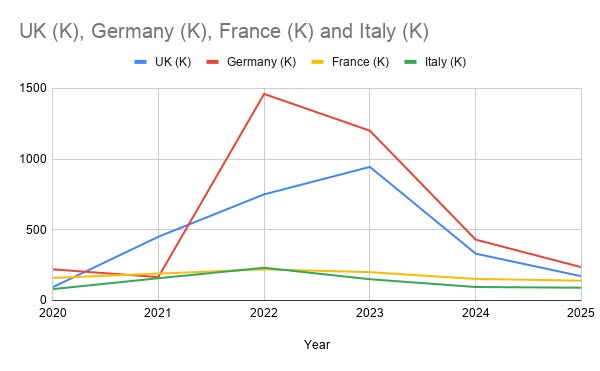
To map the reality of this economic model, one must look directly at the primary source data published by national statistical agencies. When you isolate individual countries, the mainstream media can easily frame migration numbers as isolated, domestic anomalies. But when you overlay the charts of major European nations side-by-side, the illusion of local coincidence vanishes.
The Universal Control Group
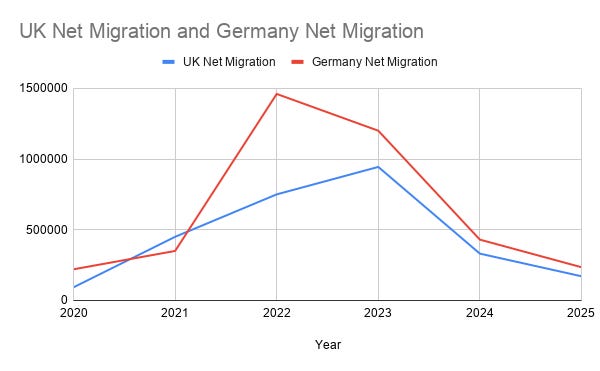
The baseline of this visual audit is captured in the official rolling 12-month net migration metrics. By tracking the data from 2014 through into 2026, three distinct, synchronized phases appear across the continent:
The 2020 Global Trough: Every single migration line across the UK, Germany, and the wider Eurozone experiences an abrupt collapse. This represents the total freeze of international travel and border lockdowns. It was during this exact domestic vacuum—while populations were confined—that broader globalist infrastructure advanced.
The 2021–2023 Rocket Launch: The moment border restrictions lifted, non-EU net migration lines detached from historical averages and went vertical. In the UK, this peaked at 944,000 for the year ending March 2023. Germany’s Destatis recorded a peak around 1.46 million net arrivals in the same post-lockdown window.
The 2025–2026 Valve-Down: Provisional ONS data for the year ending December 2025 shows UK net migration plummeting to 171,000 (provisional estimate as of recent releases; subject to future revisions). Germany’s net migration (immigrants minus emigrants) fell ~45% to ~235,000 in 2025 (from ~430,000 the prior year, per Destatis). Similar tightening occurred across several EU countries.
The synchronized nature of these net migration lines proves that Western states handle borders like a pressure valve—opened for post-pandemic labor and fiscal needs, dialed back when strains on infrastructure and public sentiment became politically unsustainable.
To understand why the net migration lines across the UK and Europe went vertical post-2020, you do not need to hunt for hidden, leaked memos. The globalist elite are completely unvarnished; they publish their intentions directly on their own websites.
When confronted with the data, establishment defenders claim that these demographic shifts are merely “interpretive” accidents of history. But a simple audit of the official literature reveals that what ordinary citizens see as an infrastructure crisis, Davos sees as a corporate “asset.” The system is operating exactly as designed.
The Institutional Timeline
The infrastructure for the post-2020 demographic explosion was locked into place well before the first visa rules were rewritten. By tracing the public record, we can map the exact transition from globalist theory to physical execution.
June 13, 2019: The Institutional Merge
At the United Nations Headquarters in New York, UN Secretary-General António Guterres and WEF Executive Chairman Klaus Schwab signed the Strategic Partnership Framework.
Official WEF announcement
This formal alliance explicitly committed both organizations to “jointly accelerate the implementation of the 2030 Agenda for Sustainable Development.” Crucially, this integrated the corporate lobbying power of Davos directly into the UN’s Sustainable Development Goals (SDGs)—specifically SDG Target 10.7, which mandates the implementation of “planned and well-managed migration policies” to facilitate global human mobility.
June 3, 2020: The “Great Reset” Declaration
Exactly one year after cementing their partnership, the WEF officially launched its “Great Reset” grand initiative. Framing the massive societal disruptions of the COVID-19 pandemic not as a crisis to be repaired, but as a unique “window of opportunity,” the WEF laid out a blueprint to overhaul global capitalism. The core of this philosophy relies on “stakeholder capitalism”—a model that bypasses local democratic accountability in favor of cross-border governance, digital transformation, and the fluid movement of labor across national boundaries.
The “Replacement” Vocabulary
Establishment fact-checkers frequently claim that documents like the UN Population Division’s “Replacement Migration: Is It a Solution to Declining and Ageing Populations?” are merely academic “modeling exercises” rather than explicit policy mandates. While technically a demographic study rather than a binding piece of legislation, this defense completely misses the point of institutional capture. The 2000/2001 UN report provided the exact intellectual vocabulary and macroeconomic justification that Western technocrats have relied on for two decades. It popularized the calculation that Western nations—specifically naming the UK, Germany, and France—must use massive, sustained inflows of foreign labor to artificially offset collapsing native birth rates and prop up aging fiscal models.
Full UN Report PDF
By the time the pandemic cleared, this advocacy had become completely dominant in elite circles. In May 2024, the WEF openly published its core stance: “Migration is a global strategic asset. We must not undermine it.” Combined with their focus on the massive $800 billion global remittance pipeline, the elite’s worldview is laid entirely bare. They do not view a nation as a historic homeland with a unique culture to be preserved; they view it as a borderless economic sector, and its sovereign population as interchangeable “human capital” units on a global corporate spreadsheet.
Domestic intellectual support for high mobility and redefined belonging has also been visible within Labour-aligned circles. The Fabian Society’s Autumn 2019 Fabian Review (”Identity Crisis” issue) featured Nandita Sharma’s “Goodbye to borders,” arguing open borders are essential to protect working people’s rights, alongside Zubaida Haque’s critique framing stricter citizenship rules as racially conditional. Both Keir Starmer and Andy Burnham have longstanding Fabian Society connections. As recently as June 2026, Burnham has faced criticism for signals that Greater Manchester could allow significant low-skilled migration settlement with access to the welfare state — illustrating continuity in regional policy thinking even amid national tightening.
(Insert UN Replacement Migration cover/document image here.)
The synchronized migration patterns visible in ONS, Destatis, and Eurostat data are not best explained by random policy errors or isolated humanitarian shocks. They reflect deep, convergent structural pressures built into the post-war Western economic and fiscal model — pressures that elite institutions like the WEF, UN, and domestic networks have explicitly framed as opportunities for “well-managed” global labor mobility.
The Demographic and Productivity Trap
Western welfare states were designed around a stable pyramid: a large working-age population funding a smaller cohort of retirees. That model has inverted. Native birth rates across the UK, Germany, and much of Europe have remained below replacement level (around 1.5 or lower) for decades. The Baby Boomer generation is retiring, living longer, and driving unprecedented demand for pensions, healthcare, and social care.
Simultaneously, productivity growth — the true engine of sustainable GDP per capita — has flatlined in the UK since the 2008 financial crisis and struggled in much of Europe. Rather than addressing root causes (chronic housing shortages that price out young families, underinvestment in domestic skills and technical education, or regulatory barriers to innovation), governments have repeatedly chosen the fastest visible lever: importing working-age adults to expand the tax base and headcount GDP in the short term.
The Migration Valve in Action
Official data shows this dynamic with striking clarity:
Post-2020 Surge: After the 2020 lockdown trough, non-EU net migration lines across major European nations went vertical. In the UK, the post-Brexit points-based system (implemented 2021) lowered certain thresholds, while humanitarian inflows (notably Ukraine) and expanded student/work visas amplified the effect. Germany and other EU states saw parallel labor and asylum-driven increases. This aligned with the “window of opportunity” rhetoric from the 2020 Great Reset and SDG frameworks emphasizing mobile human capital.
2025–2026 Coordinated Pullback: Provisional figures confirm the valve turning in near-unison. UK ONS data (year ending December 2025) shows net migration dropping to 171,000 (provisional). Germany’s Destatis reported net migration falling to ~235,000 in 2025 (down ~45% from the previous year). Similar tightening measures appeared across several EU countries in response to mounting public pressure over housing shortages, NHS-style waiting lists, and strained infrastructure.
This is not mysterious incompetence. It is the predictable behavior of a system addicted to short-term fiscal patches. Mass inflows provide immediate contributions to consumption, taxes, and certain sectors (care, logistics, retail), while remittances (~$800 billion globally in recent peaks) represent a transfer out of host economies. Corporate interests gain from labor supply that can suppress wage pressures in lower-skilled roles; Treasury spreadsheets gain headline GDP figures.
The Long-Term Cost of the Shortcut
The tragedy is that this approach exacerbates the original problems. Rapid population growth without matching infrastructure investment worsens housing crises, transport bottlenecks, and public service overload — precisely the strains driving recent policy reversals. It also delays the harder domestic reforms needed: liberalizing planning laws for family housing, boosting native fertility through family policy, and raising productivity via education and capital investment.
The public documents from the UN, WEF, and domestic networks do not “cause” every visa decision. But they supply the shared intellectual and rhetorical toolkit that makes treating sovereign nations primarily as economic zones — with populations as interchangeable units — appear as sophisticated, responsible governance rather than a managed decline strategy.
(Insert UK Net Migration Down 48% Year on Year video embed here for visual confirmation of the 2025 drop.)
The synchronized spikes across the European data ledger are not evidence of a flawless, omnipotent conspiracy. Rather, they are graphic proof of institutional capture by convergent incentives: elite networks sharing post-national economic models, Treasury reliance on headcount growth, and corporate demand for labor supply.
The UN-WEF timelines, public documents (modeling exercises and advocacy pieces), Fabian Society contributions, and lock-step data curves leave little room for the pure “accidental blunder” defense. These frameworks normalize treating nations primarily as economic zones and populations as mobile human capital.
For citizens of these historic nations, this audit raises fundamental questions:
Why prioritize short-term headline GDP over per-capita wellbeing, housing security, and social cohesion for existing residents?
Why rely on external population transfers instead of fixing structural failures—like chronic housing shortages—that prevent native families from forming and thriving?
How can democratic accountability be restored so policy better reflects the will and long-term interests of the sovereign people?
The sharp, synchronized downturns in 2025–2026 prove that borders can be controlled when political survival demands it. The task ahead is ensuring this valve serves the public interest transparently, rather than defaulting to elite spreadsheets. Sovereignty and the social contract belong to the people—not Davos models or Treasury projections.
Audit the Audit: Don’t take my word for it. Head over to the ONS provisional data tables and the German Destatis migration updates for late 2025/2026. If you find value in these open-source forensic breakdowns, consider sharing this post, subscribing to The Mirror, and dropping your thoughts in the comments below.
References
UN-WEF Strategic Partnership Framework (2019)
WEF Great Reset (2020)
UN Replacement Migration Report (2000/2001)
WEF Migration Strategic Asset (2024)
ONS Provisional Migration Data (YE Dec 2025)
Destatis Germany Migration Tables (2025)
Fabian Review Autumn 2019 (”Identity Crisis” issue)
Spiked coverage of Andy Burnham migration signals (June 2026)