If you ever needed proof that sections of the modern political class have completely lost the plot, look no further than a recent panel discussion on British television. In a clip the establishment is already desperately trying to scrub from the internet, Fabian Society Treasurer Paul Richards dropped the democratic mask and started talking like a textbook tinpot dictator.
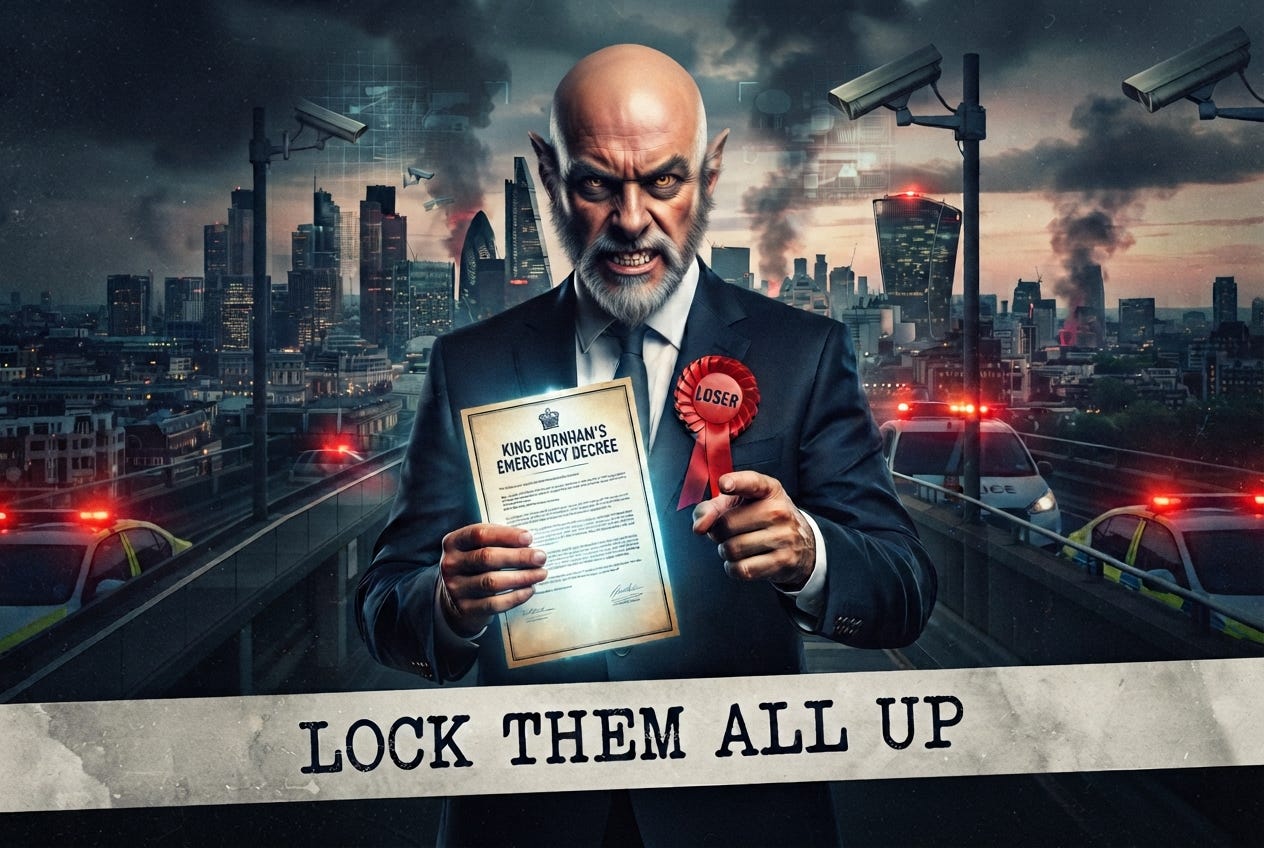
Facing the cameras, Richards casually declared that if a major conflict with Russia kicks off, the state should simply round up and imprison British citizens who voice opposition. “We would have to lock a few people up… pro-Russian voices, people who say there isn’t a threat, don’t fight for your country, that don’t go to war for Burnham,” he announced, before helpfully throwing forced military conscription onto the table as well.
Let that sink in. A senior figure in one of Labour’s oldest and most influential organisations is openly advocating the mass arrest of political dissidents and peaceful objectors under the banner of national security. It is a chillingly familiar strategy — a modern-day echo of the infamous 1933 Reichstag Fire Decree, when civil liberties were dismantled overnight to crush dissent.
To understand why rhetoric like this feels so jarringly detached from ordinary life, you have to look at the institutional pedigree behind it. Paul Richards isn’t some random keyboard warrior shouting into the void. He is a long-standing Labour insider of the purest New Labour vintage.
He served as a special adviser to two Cabinet ministers during the Blair and Brown years — Patricia Hewitt at Health and Hazel Blears at Communities and Local Government. He is a former national Chair of the Fabian Society, a long-time figure in the Blairite Progress network, a repeated Labour parliamentary candidate, and twice the party’s candidate for Sussex Police and Crime Commissioner. And he remains, to this day, the Society’s Treasurer, having been re-elected unopposed as recently as 2025.
The Fabian Society has occupied a very specific space in British politics for well over a century. Its historic modus operandi has been incremental, top-down social engineering: the quiet conviction that a clever technocratic elite knows what is best for the rest of us and should gently (or, when the pressure mounts, not so gently) manage the public from above.
Combine that worldview with the current panic-driven push toward a permanent security state and the underlying ideology becomes transparent. To a certain kind of top-down technocrat, the public is not an assembly of free citizens with inherent rights. It is a managed resource pool. If the geopolitical strategy shifts toward a war footing, then dissent, scepticism and anti-war sentiment are treated merely as logistical friction points that need to be ironed out — or locked away.
There is a delicious, devastating irony at the heart of Paul Richards’ career. This is a man who literally wrote the book on how to win elections — How to Win an Election, published in 2004 — yet his own record is a masterclass in consistent, repeated failure at the ballot box.
He ran as the Labour parliamentary candidate for Billericay in 1997 and lost.
He ran for Lewes in 2001 and lost.
He ran to be the Sussex Police and Crime Commissioner in 2021 and lost.
He ran for Sussex PCC again in 2024 and lost yet again.
The British public has repeatedly and overwhelmingly rejected him. The only election he appears capable of winning is an unopposed internal ballot to remain Treasurer of the Fabian Society. He is the elite technocrat who produces instruction manuals on how to win the public’s trust, while the public itself keeps showing him the door.
The ministries he advised as a highly paid special adviser were hardly models of success either. Patricia Hewitt was famously booed off the stage at the Royal College of Nursing conference in 2006 amid fury over NHS deficits and job cuts. Hazel Blears became one of the central figures of the 2009 expenses scandal, forced to step down from the Cabinet after it emerged she had avoided capital gains tax on her properties (she later repaid £13,000). Richards was not a bystander; he was part of the strategic apparatus surrounding these ministers at the height of New Labour’s institutional arrogance and public alienation.
And then there is the Sussex hypocrisy. The very county Richards twice tried to represent as Police and Crime Commissioner has deep, historic ties to the British Armed Forces and veterans. For a man who spent years begging local voters to trust him with community safety to turn around and demand that those same citizens — and their children — be subjected to forced conscription and state imprisonment is a total betrayal of the people he once courted.
The phrase “that don’t go to war for Burnham” is the absolute pinnacle of political arrogance. Modern politicians are elected to serve the public, protect civil liberties and manage public infrastructure. They are not kings, emperors or feudal lords entitled to absolute military obedience.
Yet this rhetoric reveals a dangerous shift in the political psyche. To these figures, a Prime Minister is no longer a temporary public servant; he is a supreme authority figure for whom ordinary citizens are expected to bleed. The public reaction has been swift and unapologetic: if the ruling elite wants a war, they can be the very first ones to lace up their boots, pick up a rifle and head to the front lines. The days of sending working-class citizens to fight political proxy wars while the masterminds sit safely in television studios are over.
Perhaps the most revealing part of this entire saga is how the corporate media reacted once the public began pushing back. Realising they had broadcast a massive liability, channels like GB News swiftly began scrubbing the clip from their official YouTube and catch-up platforms.
This isn’t just about avoiding a public relations nightmare. It is a desperate attempt to dodge a tidal wave of formal Ofcom complaints. Under UK broadcasting codes, platforming an extremist view — like calling for the mass imprisonment of citizens for exercising free speech — without immediate, robust challenge is a serious regulatory breach. But the media establishment forgets one universal rule of the digital age: the internet never forgets. The video has already gone viral across independent networks, leaving the corporate censors holding an empty bag of damage control.

Paul Richards’ casual flirtation with totalitarian tactics is a stark reminder that liberty is never permanently safe from the people who claim to manage it. When political figures start using the language of dictators, claiming that peace advocates belong behind bars, they lose all democratic legitimacy.
We do not live in an autocracy, and the British public does not belong to any prime minister or political society. The overwhelming backlash to this broadcast proves that the public still firmly believes in free speech and individual rights. If the technocrats in Westmonster want to play at being wartime generals, they can march onto their battlefield themselves.